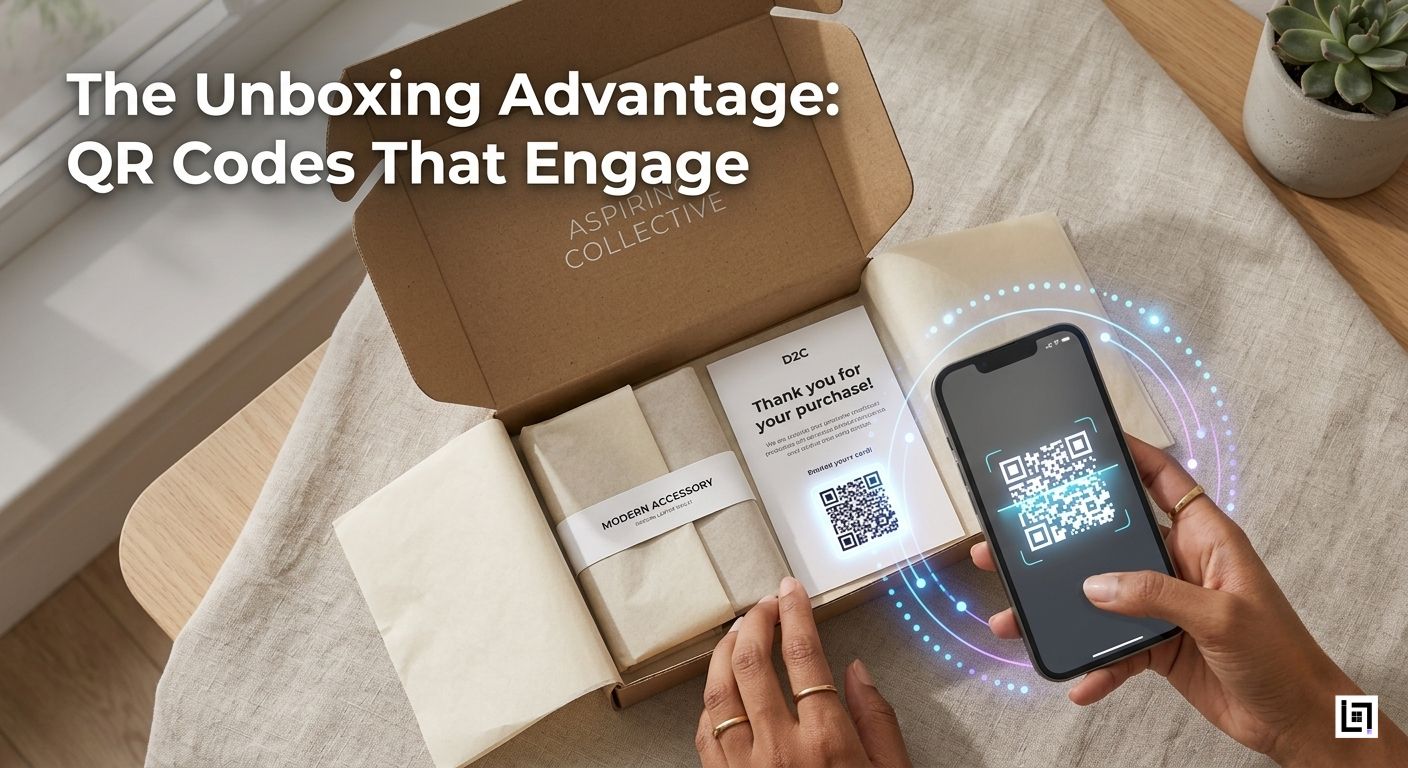
Your customer’s unboxing experience doesn’t last 30 seconds. But for most D2C brands, that’s exactly how long the engagement lasts.
The package arrives. Your customer tears through the branded tape, pulls out the product, snaps a photo for Instagram, and moves on. The thank-you card gets trashed. The multi-page instruction manual goes straight to recycling. And the post-purchase relationship effectively ends.
But what if it didn’t have to?
The most sophisticated D2C brand QR strategy flips this script entirely. Instead of a one-time transaction, packaging becomes an engagement platform. Instead of customers being left in the dark, they get instant access to tutorials, support, and easy reordering. And instead of guessing whether anyone actually reads your inserts, you get concrete data showing exactly how customers interact with your packaging.
This is the real unboxing advantage, and it starts with strategic custom packaging QR codes.
Why Post-Purchase Engagement Matters
Research shows that acquiring a new customer costs 5-25x more than retaining an existing one. Yet most D2C brands obsess over the purchase moment while ignoring the weeks and months after delivery.
Here’s what’s actually happening during those weeks: Your customer is learning how to use your product, deciding if it’s worth recommending to friends, and determining whether they’ll buy again. These are critical moments – and they’re yours to influence.
The solution isn’t sending yet another email. It’s embedding engagement directly into the unboxing experience with E-commerce packaging QR codes that make that journey seamless.
The D2C Packaging QR Mix That Actually Works
Your packaging can integrate multiple platforms in one smart, scannable format. Here’s the winning combination:
1. Amazon Reorder QR (One-Click Replenishment)
Place an Amazon product QR code prominently on your packaging – typically near where the customer would find satisfaction information. When they scan it, they land on a pre-built Amazon link to reorder consumables instantly.
Why this works: Customers don’t need to search for your product again. They don’t need to visit your website or remember your brand name. One scan, one tap, and their next batch is on the way. This single addition can increase repeat purchase rates by 10-15%.
2. TikTok Unboxing & Tutorial QR
A TikTok unboxing QR code on your packaging is surprisingly powerful. Link to a short, fun setup video – maybe showing the product in action, styling tips, or the team story behind the brand.
This transforms packaging from passive into interactive. Your customer doesn’t just own your product. They become part of your community. They see other people using it, get inspired, and (critically) share that video with their followers. It helps with getting organic reach.
3. PDF User Manual QR (No Paper Waste)
Instead of printing multi-language manuals that nobody reads, print one elegant PDF user manual QR code. Your customer can access the full guide in their preferred language, on their phone, instantly.
This does two things: It saves you money on printing and packaging weight (which reduces shipping costs), and it gives you data. You’ll see exactly how many customers actually read your documentation insight that helps you improve product design and packaging clarity.
4. Linktree Support Hub QR (Customer Support + Warranties)
A Linktree support QR acts as your post-purchase command center. Link to FAQs, warranty information, contact support, request a return, or file a damage claim. Everything in one organized landing page.
This reduces support ticket volume (customers find answers fast) while improving satisfaction (they don’t have to hunt for information).
The Hidden Advantage: Post-Purchase Tracking
Here’s what separates a basic QR strategy from a winning D2C brand QR strategy: data.
With traditional packaging inserts, you have zero visibility into what customers actually do with them. Does anyone read that thank-you card? Do they bother looking at the discount code? You’re flying blind.
Trackable QR for e-commerce changes everything. When you use dynamic QR on packaging, every scan is tracked. You can see:
- Engagement rates: What percentage of customers actually scan your codes?
- Timing: When do they scan? Immediately upon unboxing? Days later?
- Which codes work: Is your Amazon reorder link getting 100 scans per week, or zero?
- Geographic patterns: Which regions engage most with your TikTok video?
- Device data: Are iOS or Android users more engaged?
This data directly informs your strategy. If your TikTok QR gets 3x more engagement than your PDF manual, you know content is your strength – double down on video. If your Amazon reorder link is underperforming, test a different placement or design.
Real-World Impact: What Brands Are Seeing
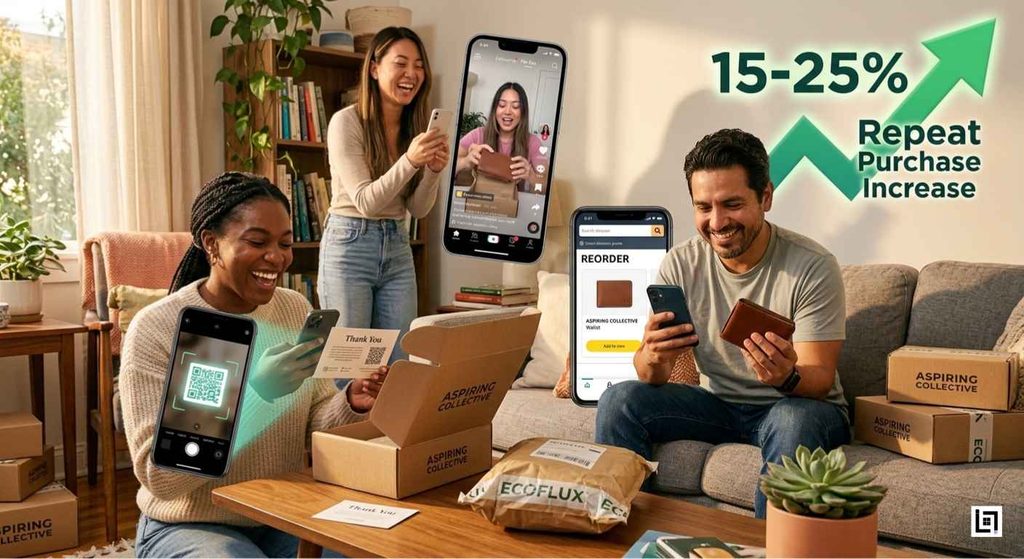
Forward-thinking E-commerce brands using custom packaging QR codes are reporting:
- 15-25% increase in repeat purchase rates (Amazon QR driving consumable reorders)
- 40-60% engagement rate on social QR codes within the first month
- 30% reduction in support tickets (Linktree hub providing instant answers)
- $2-5 saved per order in packaging weight and printing costs
- Measurable social growth from TikTok QR unboxing shares
One skincare brand added a PDF user manual QR and discovered 70% of customers were struggling with the first-use application. They adjusted product instructions and saw a 12% decrease in returns.
Implementation: Your Packaging QR Action Plan
Step 1: Decide Your Mix. Choose 3-4 of the QR types above based on your product and business model. A subscription box might prioritize the reorder link. A tech gadget might lead with tutorial videos.
Step 2: Create Dynamic QR Codes. Use a platform like ScanMyQR to create your codes. The “dynamic” part is crucial – it means you can update the destination link (change the support page URL, swap the tutorial video, refresh the discount code) without reprinting packaging.
Step 3: Design for Visibility. Place codes strategically on your packaging:
- Front/top: Your most important code (usually Amazon reorder or TikTok)
- Inside flap: Secondary codes (support, manual)
- Box bottom: Extra engagement (brand story, referral link)
Make the code visible – surrounded by white space, not camouflaged into the pattern.
Step 4: Track, Learn, Optimize. Monitor your ScanMyQR dashboard weekly. Which codes get scanned? When? From where? Adjust your packaging, copy, and placement based on real data – not assumptions.
Why ScanMyQR for D2C Brands
Unlike static QR code generators, dynamic QR platforms built for e-commerce give you:
- Update ability without reprinting (seasons change, campaigns shift).
- Unified dashboard managing codes across all product lines.
- Scan analytics showing engagement patterns.
- Scalability from single-product stores to multi-SKU operations.
- Integration with your existing email, SMS, and analytics tools.
The Future of Packaging Is Interactive
The unboxing moment is your competitive advantage. While most brands still use packaging as a static billboard, you can transform it into an engagement engine – one strategic scan at a time.
Your packaging doesn’t end the customer journey. It begins it.
Ready to turn your packaging into a retention machine? Start with ScanMyQR and create your first set of dynamic QR codes today. Your repeat purchase rate will thank you!
Leave a Reply